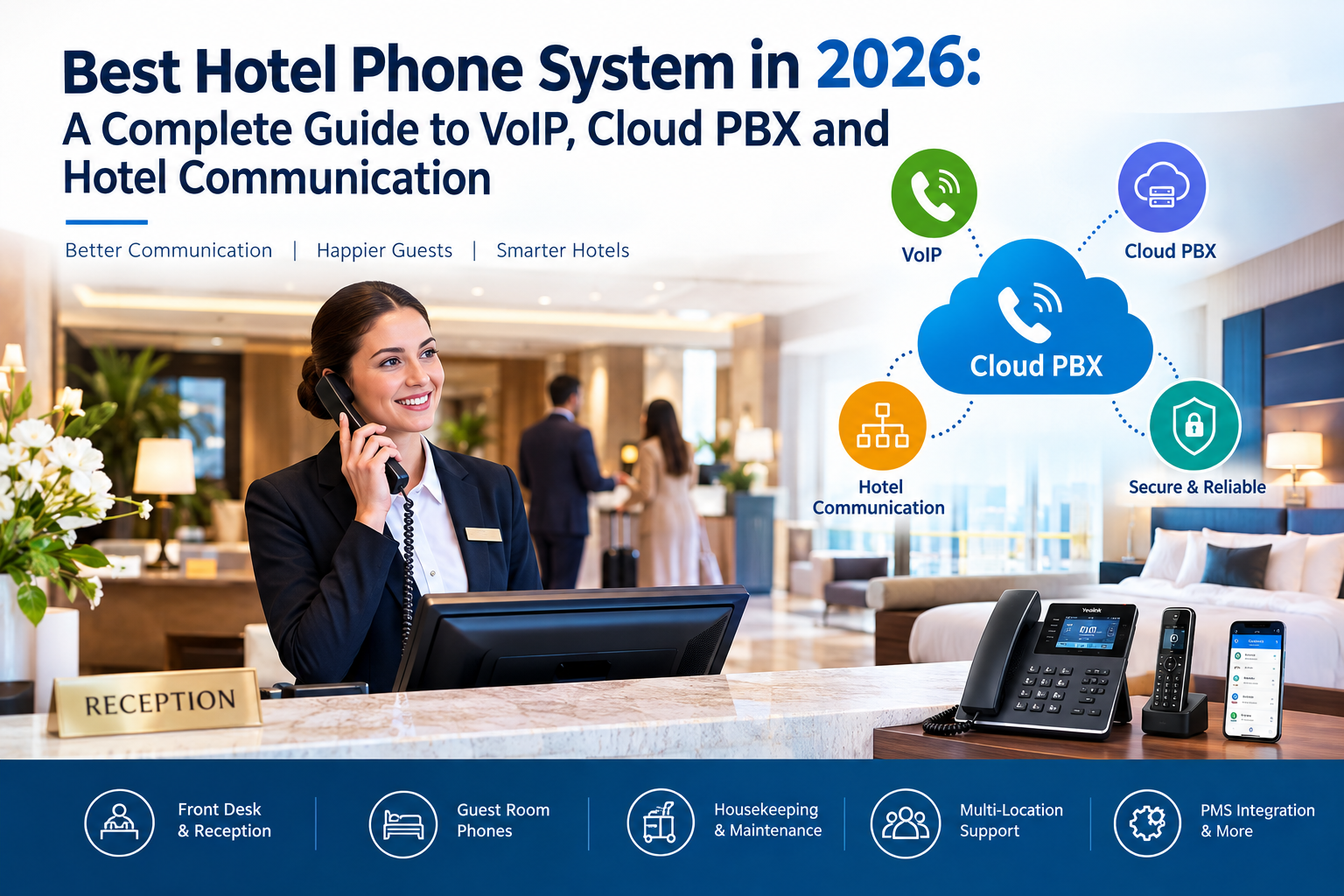
Best Hotel Phone System in 2026: A Complete Guide to VoIP, Cloud PBX and Hotel Communication
A complete foundation guide for hotel owners, operators and IT managers evaluating modern communication.
Why Hotel Communication Still Matters
A hotel may have excellent rooms, a strong restaurant and a convenient location, but guests still judge service through small interactions. A call to the front desk, a request for housekeeping, a maintenance escalation or a wake-up call can shape the overall experience. That makes the telephone system more than a collection of handsets. It is part of the operational infrastructure that connects people, departments and guest services.
Modern properties increasingly evaluate PBX, VoIP, cloud PBX, IP phones and wireless communication together rather than as isolated technologies. The goal is to create a communication environment that is easy for staff to use, simple for administrators to manage and flexible enough to grow with the property.
What Is a Hotel Phone System?
A hotel phone system is the communication platform that manages calls between guest rooms, reception, reservations, housekeeping, maintenance, restaurants, management and external callers. Depending on the architecture, it can include a traditional PBX, IP PBX, hosted cloud PBX, VoIP service, IP handsets, WiFi or DECT cordless devices and software applications.
The right architecture depends on room count, building layout, existing cabling, internet connectivity, staffing, security requirements and integration needs. A 25-room boutique property does not necessarily need the same deployment as a 500-room resort with several buildings. The important point is to match the technology to the hotel's operating model.
- Auto attendant and IVR
- Wake-up calls
- Call history and logs
- Mobile communication
- Call recording
- LTE or other backup connectivity
Traditional PBX, IP PBX and Cloud PBX
Traditional PBX systems are designed around on-site telephone equipment and physical lines. They can be dependable, but expansion and remote administration may be more involved. IP PBX systems move call control onto an IP network and can support modern handsets and software-based features.
A cloud PBX moves much of the call-management infrastructure to a hosted environment. Administrators can typically manage extensions, routing and users through online tools. Cloud architecture can be useful for hotels with multiple locations or teams that need centralized administration. It can also reduce the need to maintain a large on-site telephone server, although phones, network equipment, power protection and local connectivity still need to be planned.
How VoIP Fits Into Hotel Operations
VoIP carries voice communications over an IP network instead of relying solely on legacy telephone infrastructure. In a hotel, VoIP can connect front-desk phones, offices, guest-room extensions and mobile staff applications to a common communication platform.
For example, a front-desk employee can receive an external reservation call, transfer it to the reservations department, and later contact housekeeping using an internal extension. With appropriate configuration, managers can also access call logs, missed-call alerts or other administration tools. These capabilities are useful when the phone system is designed around real hotel workflows rather than simply installed as a set of endpoints.
Why IP Phones Matter
IP phones provide the physical interface employees use to access a VoIP or IP PBX environment. Hotel offices may use multi-line desk phones, while guest rooms may use hospitality-focused handsets or compatible IP devices. The selection should consider durability, usability, button layout, power requirements, network design and the functions guests actually need.
Hotels evaluating hotel IP phones can review IP phone capabilities such as programmable keys, multiple extensions and integration with cloud or hosted phone platforms. The choice of handset should be made together with the PBX and network plan so that the complete system works consistently.
- Guest-room extensions
- Front-desk call transfer
- Auto attendant and IVR
- Wake-up calls
- Call history and logs
- Mobile communication
Wireless Communication for Housekeeping and Maintenance
Not every hotel employee works behind a desk. Housekeeping, engineering, maintenance, security and management teams move through corridors, guest floors, public areas and service spaces. A wireless communication layer can therefore be valuable.
A hotel WiFi phone system can use cordless DECT or WiFi-connected devices to keep mobile staff reachable while they work. The website describes support for features such as secure cordless communication, push-to-talk, messaging and call handover, along with integration into cloud PBX or VoIP environments. For a property with large floors or multiple service areas, coverage planning is important so that staff do not encounter avoidable dead zones.
Features to Look For
The best hotel phone system is not defined by the longest feature list. Hotels should prioritize features that improve guest service and reduce operational friction. Useful capabilities can include auto attendant, call transfer, call forwarding, voicemail, call history, call logs, missed-call alerts, wake-up calls, call recording, mobile applications and SMS integration.
The provider's current hospitality solution pages also describe real-time alerts, LTE backup, UPS battery backup, professional installation and technical support. These capabilities illustrate an important buying principle: availability and operational continuity should be considered alongside call features.
- Call history and logs
- Mobile communication
- Call recording
- LTE or other backup connectivity
- Guest-room extensions
- Front-desk call transfer
Front Desk and Guest Room Workflows
Reception is often the center of hotel communication. The system should make it easy to answer calls, identify departments, transfer calls and contact guest rooms. Guest rooms should have simple dialing instructions and predictable access to reception or service departments.
A well-designed extension plan can reserve logical ranges for guest rooms while assigning separate groups to housekeeping, engineering, reservations, food and beverage and management. Clear naming and numbering reduce training time and make troubleshooting easier. If the property has multiple buildings, the numbering plan should also make the location obvious to staff.
Network, Power and Reliability
VoIP depends on the underlying network. A hotel should review internet bandwidth, LAN capacity, VLAN design, Quality of Service, WiFi coverage where applicable, firewall rules, switching, power and backup connectivity before deployment. The objective is not simply to have internet access but to provide a stable environment for real-time voice traffic.
Power continuity is also important. The current solution information describes UPS battery backup and LTE failover as available continuity measures. Hotels should evaluate which components require backup power and how calls should be handled if the primary internet connection becomes unavailable.
- Guest-room extensions
- Front-desk call transfer
- Auto attendant and IVR
- Wake-up calls
- Call history and logs
- Mobile communication
Security and Administration
A hotel phone system can handle internal communications, guest-service calls and potentially sensitive business information. Administrators should use strong credentials, role-based access, secure remote management, network segmentation and appropriate update procedures. Call recording should be configured according to applicable privacy and legal requirements.
Administrative simplicity also matters. A system that lets authorized users add extensions, change routing and review call activity through a central interface can reduce dependence on manual configuration. For multi-property groups, centralized controls can provide consistency while still allowing property-specific rules.
Choosing the Right System
Start by documenting the property's current environment: number of rooms, departments, buildings, phone numbers, existing PBX, cabling, internet providers, guest-room devices and software integrations. Then define future requirements such as adding rooms, opening another property, supporting mobile employees or connecting a reservation center.
Request a solution design rather than comparing only monthly prices. The proposal should identify the PBX architecture, endpoints, network assumptions, implementation plan, support model, backup strategy and recurring costs. A good evaluation also includes staff training and a migration plan that minimizes disruption.
Final Takeaway
A modern hotel phone system can combine PBX control, VoIP calling, cloud administration, IP phones and wireless communication into one operational platform. The right solution is the one that fits the property's workflow, infrastructure and growth plans.
Hotels can start by reviewing hotel VoIP phone system, hotel IP phones and hotel WiFi phone system, then map those capabilities against their own requirements. A thoughtful design can help the front desk respond faster, keep mobile teams connected and provide guests with a consistent communication experience.
Frequently Asked Questions
What is a hotel phone system?
The answer depends on the hotel's room count, network design, staffing model and communication requirements. The property should document the workflow first and then confirm the feature, compatibility and support details with the selected provider.
Is VoIP suitable for hotels?
The answer depends on the hotel's room count, network design, staffing model and communication requirements. The property should document the workflow first and then confirm the feature, compatibility and support details with the selected provider.
What is the difference between PBX and cloud PBX?
The answer depends on the hotel's room count, network design, staffing model and communication requirements. The property should document the workflow first and then confirm the feature, compatibility and support details with the selected provider.
Can a hotel use IP phones in guest rooms?
The answer depends on the hotel's room count, network design, staffing model and communication requirements. The property should document the workflow first and then confirm the feature, compatibility and support details with the selected provider.
Why would housekeeping need wireless phones?
The answer depends on the hotel's room count, network design, staffing model and communication requirements. The property should document the workflow first and then confirm the feature, compatibility and support details with the selected provider.
Can a hotel phone system support multiple buildings?
The answer depends on the hotel's room count, network design, staffing model and communication requirements. The property should document the workflow first and then confirm the feature, compatibility and support details with the selected provider.
What network requirements should a hotel check before installing VoIP?
The answer depends on the hotel's room count, network design, staffing model and communication requirements. The property should document the workflow first and then confirm the feature, compatibility and support details with the selected provider.
Can hotel phone systems support wake-up calls?
The answer depends on the hotel's room count, network design, staffing model and communication requirements. The property should document the workflow first and then confirm the feature, compatibility and support details with the selected provider.
How can a hotel reduce communication downtime?
The answer depends on the hotel's room count, network design, staffing model and communication requirements. The property should document the workflow first and then confirm the feature, compatibility and support details with the selected provider.
What should a hotel ask a phone-system provider?
The answer depends on the hotel's room count, network design, staffing model and communication requirements. The property should document the workflow first and then confirm the feature, compatibility and support details with the selected provider.